   |
|
Mullion and Area |
|
    |
|
| Local Walks Local Accommodation and Business | |
|
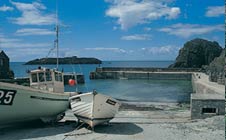
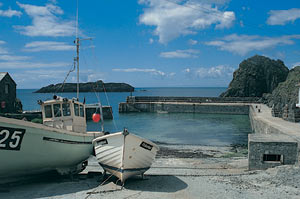
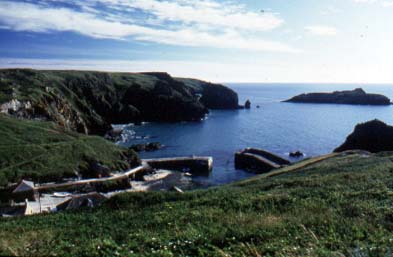
Mullion Cove has a pretty working harbour, protected from the winter gales that rage across Mount's Bay by two stout sea walls. The harbour was completed in 1895 and financed by Lord Robartes of Lanhydrock as a recompense to the fishermen for several disastrous pilchard seasons.
The cove had a lifeboat station frorn 1867 - 1909, and with good reason: in the six years tip to 1873 there were nine wrecks under Mullion cliffs, along a mile-and-a-half stretch of coastline. Inland are the remains of Wheal Unity copper mine, which operated from the early, 18th century to 1919. A large copper boulder from the mine is in the Natural History Museum, London.
|
|
|
Holiday Cottages - Self-catering Holidays - B&B Accommodation on the Lizard
|
 Mullion
is the largest village on the Lizard and has shops, inns, cafes and
restaurants, craft shops and art galleries. In the centre ofthe village,
the 15th century church of St Mellanus is renowned for its richly-carved
oak bench-ends depicting biblical scenes, including that of Jonah and
the Whale.
Mullion
is the largest village on the Lizard and has shops, inns, cafes and
restaurants, craft shops and art galleries. In the centre ofthe village,
the 15th century church of St Mellanus is renowned for its richly-carved
oak bench-ends depicting biblical scenes, including that of Jonah and
the Whale. 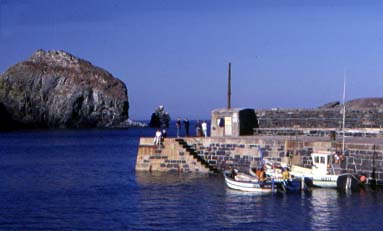 You
can still see the old pilchard cellar and net store. There are plenty
of smuggling tales too. In 1801, the King's Pardon was offered to any
smuggler giving information on the Mullion musket men involved in a
gunfight with the crew of HM Gun Vessel Hecate.
You
can still see the old pilchard cellar and net store. There are plenty
of smuggling tales too. In 1801, the King's Pardon was offered to any
smuggler giving information on the Mullion musket men involved in a
gunfight with the crew of HM Gun Vessel Hecate.
 Nearby
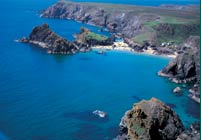
Poldhu Cove is an ideal and easily accessible family beach. In December
1901, on the cliffs, above Poldbu, Guglielmo Marconi conducted his famious
experiment in trans Atlantic radio communications. The beach at Polurrian
Cove, popular with surfers, is approached by an attractive walk along
the cliffs, or through a valley, and is well worth the effort.
Nearby
Poldhu Cove is an ideal and easily accessible family beach. In December
1901, on the cliffs, above Poldbu, Guglielmo Marconi conducted his famious
experiment in trans Atlantic radio communications. The beach at Polurrian
Cove, popular with surfers, is approached by an attractive walk along
the cliffs, or through a valley, and is well worth the effort.